
Rush County Court Records After Arrest
After an arrest in Rush County, three public offices may touch different parts of the same event. The Rush County Sheriff's Office, led by Sheriff Mark Knowles, handles custody and jail records at 715 Elm, PO Box 495, LaCrosse, KS 67548. The Rush County Attorney, Tony W. Rues, reviews the law-enforcement referral and decides whether to file, amend, divert, or dismiss criminal charges. The Rush County District Court, with Clerk Erin Werth, maintains the court records once a case exists.
That split matters because booking charges are not the same thing as filed court charges. A deputy or another arresting officer may use one label at intake, then the county attorney may file a different charge description or statute after review. Court records after an arrest may show a complaint, hearing date, warrant entry, bond order, plea, dismissal, diversion, sentence, or other docket event. Custody and booking detail belongs with jail inmate records, while booking photos are treated separately on the jail mugshots page.
The county research did not locate an official Rush County online jail roster or court case feed on the county website. For court records, the statewide Kansas District Court Public Access Portal is the main online starting point. For custody, call the sheriff at 785-222-2578 or email sheriff@rushcountykansas.gov. For case filing questions, the court clerk can be reached at 785-222-2718, and the county attorney's office can be reached at 785-222-3736.
Search Rush County Court Records
Use Kansas Case Search for public district court records after a Rush County arrest. The portal is statewide, so a Rush County name search may return cases from more than one county if the person has court activity elsewhere in Kansas. Use a case number when one is known from a citation, complaint, warrant, bond paper, or court notice. If no case appears right after a jail arrest, the case may not have been filed yet, or the search terms may not match the court index.
The Kansas District Court Public Access Portal is the source shown in the case-search screenshot below.
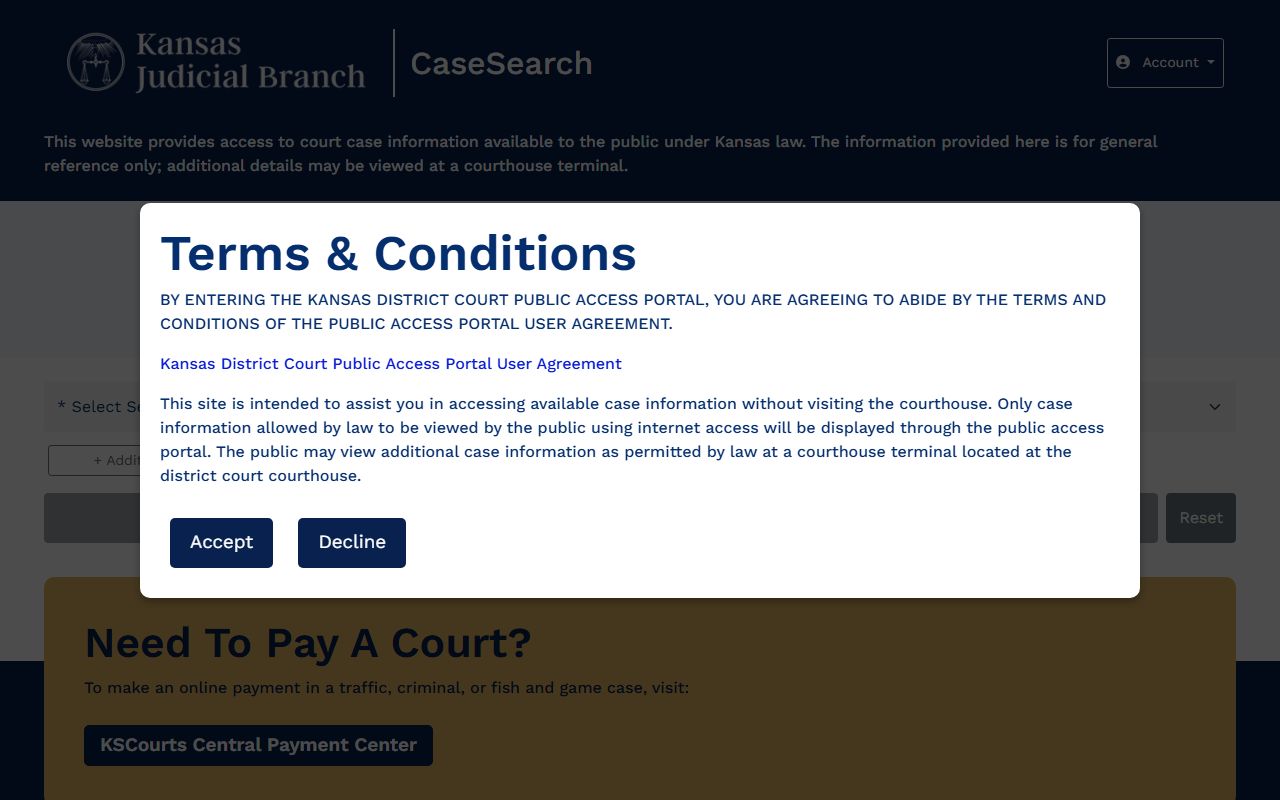
The portal supports the case side of the arrest pathway, while the Rush County sheriff remains the local contact for booking and custody information.
- Open Kansas Case Search and choose the public case-search route available to the user.
- Search by defendant name, case number, business name, citation, or other role-specific criteria shown by the portal.
- Open the case result that matches Rush County, the correct party, and the likely filing date.
- Read the charge list, charge level, court dates, warrant entries, bond orders, and current case status.
- Call Rush County District Court at 785-222-2718 if the public portal does not answer a case-specific docket question.
| Search Field | Use | Notes |
|---|---|---|
| Case number | Best route when known | Use numbers from a citation, complaint, warrant, or court notice. |
| Party name | Defendant lookup | Try full legal name and reasonable spelling variants. |
| Business name | Business-party cases | Less common for jail arrest matters, but available in the portal. |
| Citation | Traffic or citation case | Useful when the arrest began with a citation or traffic matter. |
| Role-specific criteria | Variable | The portal may show different options based on the user's access role. |
Rush County Arrest Charging Records
The court record starts with a charging document or docket entry, not with the jail intake screen. In Rush County, the county attorney is the local charging authority for state-law criminal cases after law enforcement submits reports. A complaint, information, or indictment can all be used to state the accusation in court. The exact document depends on the type of case and the way the prosecution proceeds.
A charge filed after an arrest may not match the first booking label. A booking label is often a short law-enforcement description used to hold or process the person. A filed charge is the court accusation the prosecutor chooses to pursue. Later, the prosecutor may amend the count, add a count, reduce a count, dismiss a count, or resolve the case through diversion, plea, trial, sentencing, or another disposition.
| Complaint | Information | Indictment | |
|---|---|---|---|
| Filed By | Officer or prosecutor | Prosecutor | Grand jury |
| Common Use | Early criminal filing or misdemeanor accusation | Many felony prosecutions | Serious cases brought through a grand-jury process |
| Effect | States the accusation and opens court tracking | States formal prosecutor charges | States charges returned by the grand jury |
| Rush County Check | Search the court case and ask the clerk if copies are available | Review the docket and charge history | Confirm through the court because grand-jury use is case specific |
Rush County Charge Status
Charge status is the reason court records after an arrest should be checked more than once. A case can be pending at first appearance, then later amended, reduced, dismissed, diverted, or sentenced. Bond can also change as the case moves. Kansas Case Search may show the docket and charge status, but the court clerk is the source for local record access questions, and the county attorney controls prosecution decisions.
Use plain terms when reading a docket. A pending charge is still active. A dismissed charge is no longer being pursued in that case. A conviction means guilt was entered by plea or found by the court or jury. Diversion can pause prosecution under a written agreement, but public criminal-history release rules can treat diversion differently from a conviction.
| Status | What It Means |
|---|---|
| Pending | The charge is active and has not reached final disposition. |
| Amended or Reduced | The prosecutor changed the charge, level, count, or wording after review or agreement. |
| Dismissed | The charge was ended in that case, although other counts or cases may remain. |
| Diversion | The case may be paused under conditions, with dismissal possible if terms are met. |
| Convicted | The charge resulted in a plea, verdict, or judgment of guilt. |
Note: A person can have no current Rush County jail custody and still have an active Rush County court case.
Rush County Arrest Bond Records
Bond and release details sit between jail custody and court records. The research did not locate a Rush County bond schedule, online bond-payment vendor, jail cashier hours, or confirmed payment methods. The practical route is to confirm custody and bond status with the Rush County Sheriff's Office, then confirm the case or warrant status with Rush County District Court or Kansas Case Search. If bond is allowed, ask whether payment is made through the sheriff, the court clerk, or a licensed surety agent.
A hold can block release even when one Rush County charge has a bond amount. The hold might come from another county, a city case, KDOC parole or probation, federal authorities, immigration custody, or another warrant. K.S.A. 19-1930 allows Kansas county jails to receive certain prisoners committed by U.S., city, and KDOC authority when proper legal authority exists. The same statute protects professional attorney visits at reasonable hours for prisoners held in county jail.
| Bond Type | How It Works |
|---|---|
| Cash bond | The required amount is paid in cash or another accepted form, subject to local instructions. |
| Surety bond | A licensed bail agent posts bond under the terms set by the court. |
| PR bond | Personal recognizance release allows release without full cash payment, usually with court conditions. |
| No-bond hold | Release is not available until a judge acts or the hold is cleared. |
| Outside detainer | Another agency asks that the person remain held or be transferred after local processing. |
Rush County Arrest Warrants
No official Rush County active-warrant list or public warrant-search portal was located on the county website. That means warrant checks should be routed through the Rush County Sheriff's Office, Rush County District Court, Kansas Case Search, and an attorney when there is risk of arrest. Do not rely on commercial warrant pages as proof that a warrant exists or has cleared.
Common warrant terms can mean different things. An arrest warrant authorizes taking a person into custody. A bench warrant is usually issued by a judge for failure to appear or failure to obey a court order. A search warrant authorizes a search, not a custody hold by itself. A fugitive or outside warrant can lead to booking in Rush County while another agency decides whether to pick up the person.
Kansas Attorney General guidance notes that affidavits or sworn testimony supporting arrest or search warrants use a separate court procedure, not a simple KORA request. Basic warrant status may be available from the court or sheriff, but supporting materials can be restricted by court order or statute.
Rush County Charges vs Convictions
An arrest and a charge do not mean a conviction. Court records after a jail arrest show accusations as the case develops. The record may later show dismissal, acquittal, conviction, diversion, amendment, or sentencing. Kansas criminal-history release rules also draw lines between adult conviction history, recent arrests without disposition, active diversions, disposed non-convictions, completed diversions, expunged records, and juvenile records.
| Charge | Conviction | |
|---|---|---|
| Stage | An accusation filed or tracked in court | A plea, verdict, or judgment of guilt |
| Proof Level | Based on probable cause or filed accusation | Based on proof beyond a reasonable doubt or a valid plea |
| Record Effect | May appear while pending, amended, or dismissed | May appear as criminal-history information that is publicly releasable when allowed |
| Where to Check | Kansas Case Search and Rush County District Court | Kansas Case Search, court records, and the KBI criminal-history channel |
Rush County Sealed Arrest Records
Some court records after an arrest may be sealed, expunged, or otherwise withheld from broad public view. Kansas public access rules do not make every law-enforcement or court document public in the same way. Juvenile records, sealed charges, expunged matters, certain dismissed matters, and ongoing investigation records can have limits that do not apply to an ordinary public docket sheet.
The Kansas Open Records Act is the baseline for agency records. K.S.A. 45-217 defines public records and criminal investigation records. K.S.A. 45-220 covers request procedures for access and copies. K.S.A. 45-221 lists categories that are not required to be disclosed, including criminal investigation records that may be discretionarily closed.
| Sealed | Expunged | |
|---|---|---|
| Public View | Hidden or limited by court rule or order | Treated as removed from ordinary public access when the expungement applies |
| Agency Access | Some government or court users may still have access | Access depends on Kansas law and the order entered |
| How It Happens | Usually by court rule, statute, or order | Usually requires an eligible case and a court order |
| Rush County Route | Ask Rush County District Court about the case file status | Use court process and provide the order to record custodians when needed |
Rush County Background Checks
For statewide criminal-history records, use the Kansas Bureau of Investigation Central Repository record-check channel. The research notes that a public name-based Kansas record check costs $30. Public release can include adult conviction history, municipal or county ordinance convictions that match state crimes, KDOC confinements, arrests within the past 12 months when disposition has not been received, and active diversions. It does not release disposed non-conviction arrests, completed diversions, expunged records, older arrests without disposition, or juvenile records to the general public.
Important: Do not use general public-record lookups for employment, tenant, credit, insurance, or other FCRA-regulated screening.
Restricted Rush County Court Records
Public court dockets are broader than law-enforcement investigative files, but they are not unlimited. The Kansas Attorney General KORA FAQ states that court records and docket sheets may not be closed as criminal investigation records, while other court rules may still close specific records. That means a basic docket can be public while affidavits, juvenile material, sealed exhibits, protected victim information, medical information, or an investigative file remains restricted.
The safest request is precise. Give the person's full name, date of birth if known, case number if known, arrest or filing date, and the exact record sought. For Rush County court records after an arrest, ask the court clerk about docket access and copies. For jail or booking records, ask the sheriff's office. For prosecution status, contact the Rush County Attorney's Office, while understanding that prosecutors may not discuss every pending case detail with the public.
Note: A KORA request is not the same as legal advice, discovery, or a court order for sealed records.